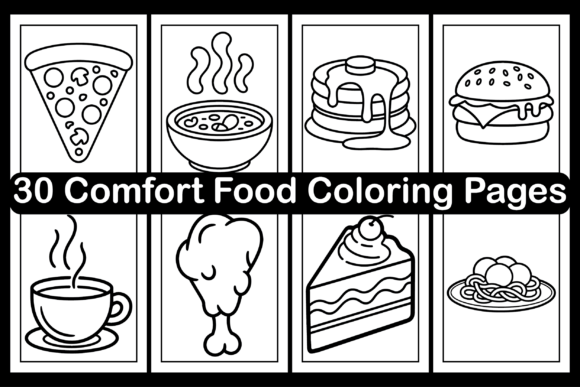
30 Comfort Food Coloring Pages
As a designer who’s stitched everything from nursery pillows to boutique aprons—and reviewed hundreds of digital design bundles—I opened 30 Comfort Food Coloring Pages expecting charm, but what stood out immediately was its quiet versatility. This isn’t just a collection of doodles; it’s a cohesive visual language built around warmth, nostalgia, and approachable detail—exactly the kind of mood that translates beautifully into handmade embroidery projects.
I tested it first on a custom embroidered tote bag for a local café owner: think thick cotton canvas, medium-weight tear-away stabilizer, and soft matte thread in buttery yellow, sage green, and warm brown. The line work held up perfectly—clean curves on a cinnamon roll, subtle cross-hatching in a slice of apple pie, open spaces in a steaming mug that let the fabric breathe. No overcrowded fills, no micro-detail traps. That’s rare in coloring-page-derived embroidery assets, and it matters—especially when you’re stitching at scale for a small shop or Etsy listing.
Where This Bundle Feels Like Home
30 Comfort Food Coloring Pages shines brightest where authenticity and tactile appeal intersect. Think:
- Embroidered tea towels and kitchen aprons—simple outlines stitch quickly, and the food motifs read clearly even at 3–4 inches wide.
- Baby onesies and burp cloths—soft shapes (a smiling donut, a stacked waffle) avoid sharp angles and dense fill areas that can stiffen delicate fabrics.
- Patches and iron-ons—many designs have natural borders or gentle negative space, making them easy to digitize as clean satin-stitched edges or minimalist running-stitch outlines.
- Holiday gifts and personalized sweatshirts—pair a single piece (like “Hot Cocoa” or “Pumpkin Pie”) with a monogram or date for instant sentimental value.
- Digital product previews—use the clean linework in printable mockups for Etsy listings or craft fair signage without worrying about pixelation or muddy edges.
It’s also well-suited for small business branding: imagine stitching “Mac & Cheese” onto a chef’s cap for a food truck, or “Oatmeal Cookie” on a linen pillow cover sold alongside artisanal baking mixes. The tone is friendly but not childish—ideal for adult crafters, gift buyers, and boutique owners who want handmade charm without cutesy overload.
Real Embroidery Considerations—What Works (and What Needs Care)
This bundle leans into simplicity by design—and that’s its strength—but simplicity doesn’t mean zero prep. Here’s how it behaves across common real-world scenarios:
On stretchy fabric like knits or baby jersey? Use cut-away stabilizer underneath and keep hoop tension consistent—those smooth curves rely on stable fabric movement. On dark fabric, test thread contrast early: light tan or cream thread reads well against navy or charcoal, but avoid pale yellow on black unless you’re adding a white underlay.
For curved surfaces like caps or curved pillow seams, prioritize designs with fewer interior details—“Grilled Cheese Sandwich” or “Mug of Tea” adapt better than “Layered Birthday Cake” with fine tier lines. And while most pieces are generous in size, avoid shrinking any below 2.5 inches if you plan to use them on tiny hoops (like 3” x 3”)—some flourishes (e.g., steam swirls, fork tines) lose clarity when compressed.
Also note: because these originate as coloring pages, they’re inherently line-based—not pre-digitized embroidery files. That means you’ll need to digitize them yourself or hire a digitizer. Don’t assume automatic tracing will capture the rhythm of a hand-drawn waffle grid or the gentle taper of a spoon handle. Manual cleanup pays off in stitch clarity and professional finish.
Why It Builds Trust—Not Just Texture
Customers notice when a design feels intentional, not imported. A well-executed embroidered “Biscuit & Gravy” on a linen napkin signals care—not just craft. 30 Comfort Food Coloring Pages supports that perception because its consistency in weight, spacing, and theme tells a story before a single stitch is made.
That cohesion boosts brand consistency for Etsy sellers launching a “cozy kitchen” collection, helps maintain giftability (no jarring style shifts between a tea towel and matching oven mitt), and strengthens buyer engagement—people recognize comfort food as shared cultural shorthand, and that emotional resonance carries through to your finished product.
It also avoids overdesigning—a trap many digital bundles fall into. There’s no forced symmetry, no excessive ornamentation. That restraint makes it easier to pair with other design assets, integrate into existing product lines, or adapt for seasonal updates (add a tiny snowflake beside the mug for winter, a lemon wedge beside the iced tea for summer).
Practical Designer Notes Before You Stitch
Before committing to a full run—or listing a finished item—here’s what I do every time with coloring-page-derived embroidery assets like 30 Comfort Food Coloring Pages:
- Run a test on scrap fabric *with your exact stabilizer and thread*—not just once, but twice: one at intended size, one slightly scaled down to check legibility.
- View the design in black-and-white mockup mode—this reveals unintended density or thin lines that vanish on dark backgrounds.
- Compare how it reads on light vs. dark fabric using simple photo overlays—some motifs (like “Cupcake with Sprinkles”) gain energy on black, while others (“Steaming Bowl of Soup”) soften too much.
- Check licensing carefully: this is marketed for KDP interior, POD, and resale as-is—but if you’re selling physical embroidered items, confirm whether commercial use of the underlying artwork is permitted.
- When digitizing, simplify where needed: convert tight clusters of lines into gentle satin stitches, leave breathing room around lettering, and avoid filling large open areas unless texture serves your product goal (e.g., a quilted pillow cover vs. a crisp tote).
Finally—don’t skip the stabilizer step. These designs look effortless, but their clean lines depend on stability. Medium-weight cut-away works for most apparel; lightweight tear-away is ideal for tea towels and patches.
In short: 30 Comfort Food Coloring Pages isn’t flashy—but it’s reliable, adaptable, and quietly thoughtful. For embroidery designers and creative entrepreneurs who value substance over sparkle, it’s a refreshingly grounded set of design assets—one that earns its place in real projects, not just preview thumbnails.