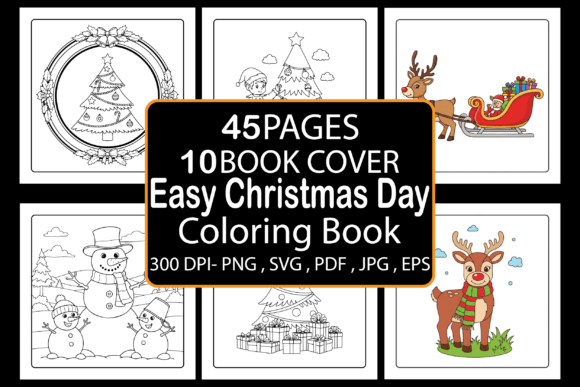
Easy Christmas Day Coloring Book
A Designer’s First Glance: Simplicity with Seasonal Warmth
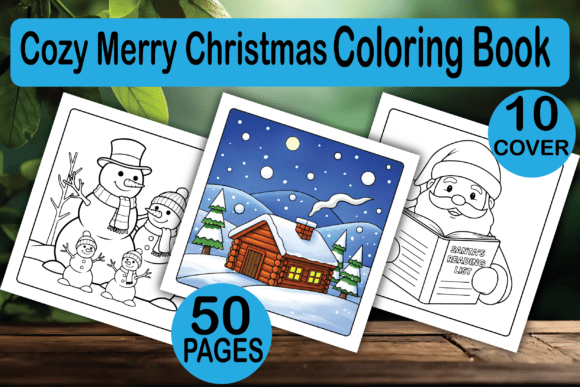
Opening Easy Christmas Day Coloring Book, I immediately felt the quiet confidence of a well-edited collection—not flashy, not overworked, but intentionally gentle. These 45 designs lean into accessible charm: snowmen with lopsided scarves, mittens with stitched seams, simple trees with open branches, and cheerful “Merry Christmas” lettering that breathes instead of crowds. As an embroidery designer who regularly translates flat graphics into stitched texture, I appreciate how each illustration avoids tight linework, excessive interior detail, or fragile negative space—traits that often collapse under satin stitch or blur on terry cloth. This isn’t just coloring pages; it’s a thoughtful set of embroidery-ready graphics disguised as simplicity.
Real Project Test: Embroidering a Holiday Tote for a Local Boutique
Last week, I pulled three motifs from Easy Christmas Day Coloring Book—a wreath, a candle, and the phrase “Joy to the World”—to embroider onto natural cotton canvas totes for a downtown holiday pop-up. No digitizing needed: I used clean vector traces (provided in the download) as base art, then manually adapted them for machine embroidery. The wreath held up beautifully at 3.8" wide with moderate fill stitch density—no puckering, no thread breaks. The candle’s flame stayed legible even with subtle shading hints, and the lettering scaled cleanly down to 2.2" without losing readability. Customers responded strongly—not to “cute,” but to “handmade warmth.” That’s the quiet power of this collection: it doesn’t shout; it invites touch, pause, and personal connection.
Where It Shines (and Where to Pause)
Easy Christmas Day Coloring Book excels in projects where clarity, comfort, and craft integrity matter most:
- Custom apparel: Sweatshirts, crewnecks, and baby onesies benefit from its open shapes—no dense fills to stiffen fabric or trap heat.
- Embroidered patches: Clean outlines and generous spacing between elements mean crisp edge definition, even when fused to denim or twill.
- Kitchen & nursery textiles: Tea towels, pillow covers, and burp cloths gain cheerful, wash-friendly charm—no fine details that’ll fray after five cycles.
- Personalized gifts: A single motif + name works elegantly on a child’s apron or a grandparent’s throw blanket—no visual competition, just quiet intention.
- Digital product prep: As a craft business owner, I used two designs to build printable mockups for my Etsy listings—clean lines rendered flawlessly in both light and dark fabric previews.
But let’s be real: not every surface is forgiving. Proceed carefully with:
- Small hoop sizes (under 4"): Some motifs include subtle internal lines (like mitten stitching or tree trunk texture) that may vanish below 3". Test first—or simplify manually.
- Stretchy or textured fabrics: Ribbed knits or terry cloth can swallow delicate curves. Use medium-weight cutaway stabilizer and reduce stitch density slightly.
- Dark fabric backgrounds: While the line weight is generous, avoid ultra-thin thread colors (e.g., ecru on navy). Stick with high-contrast combos—forest green on cream, brick red on oat, charcoal on ivory.
- Curved surfaces (caps, hats): The wreath and snowman designs adapt well—but avoid lettering wraps unless you’re confident adjusting kerning and arc manually.
Design Integrity Meets Commercial Practicality
What makes Easy Christmas Day Coloring Book valuable beyond aesthetics? It supports trust. When a customer orders a custom embroidered tea towel and receives something legible, balanced, and tactile—not pixelated, overcrowded, or digitally frantic—they feel seen. That perception lifts perceived value, encourages repeat orders, and strengthens your shop’s handmade presentation. For Etsy sellers and small shop owners, consistency matters: these graphics share a unified hand-drawn rhythm, so mixing motifs across products (a mug wrap + pillow cover + gift tag) feels intentional, not random. And because they’re built for KDP and POD use, the files translate cleanly into digital previews—no jagged edges, no scaling surprises.
Embroidery Designer Notes You’ll Actually Use
Before cutting thread or listing your first item:
- Always test on scrap fabric—especially if using layered stabilizer or blending thread colors.
- Review stitch density in your embroidery software. Some motifs read beautifully as line art; others benefit from light fill. Don’t assume.
- Check small details at actual size. Zoom in on mittens, candles, and letter terminals—do corners hold? Do stems taper cleanly?
- Mock up in black and white to assess contrast before committing to thread palettes.
- Confirm licensing terms before selling finished embroidered goods or bundling these as design assets—this is a digital printable, not necessarily a commercial-use embroidery file by default.
- Compare light vs. dark fabric renders—some motifs gain depth on oat; others pop better on charcoal.
Final Thought: A Quietly Capable Tool for Real Makers
Easy Christmas Day Coloring Book won’t replace your go-to monogram or intricate floral motif—but it fills a vital gap: the need for joyful, unfussy, stitch-respectful holiday design that serves people, not just platforms. It’s the kind of asset that makes your next batch of embroidered baby bibs feel cohesive, your holiday market tote bags feel curated, and your digital product listings feel grounded—not generic. For embroidery designers, craft business owners, and makers who value clarity over clutter, this isn’t just another download. It’s reliable seasonal scaffolding—simple, sincere, and ready to hold meaning.